

The deadline for candidates to register to run for Town Council against incumbents Manu Danny and Holly Garland is this Friday, February 13th at 5 PM. So far, both candidates are running unopposed, but there will still be an election in May. On a Saturday, which may surprise some people1. Given that this is not a national election and we may not even have candidates campaigning to remind us of the election, voter turnout is likely going to be low.
We are still having an election because from July to January, our town’s Charter Review Committee has been meeting regularly and working out changes they’d like to propose to the Town Charter. These charter reviews are actually required by the Town Charter itself every 5 years, and we are overdue. In January, the committee gave their proposals to the town’s attorneys, who turned their suggestions into 19 (yes, nineteen!) individual provisions residents will have to individually approve May 2nd.
Why so many different provisions on the ballot?
During the February 9th Town Council meeting, Town Secretary Rachel Ramsey read through each of the provisions and answered questions from the Mayor and Town Council, and Charter Review Committee member Meghan McCaig also stepped up to help clarify the intent behind certain provisions. Through this back-and-forth (especially right at the 2:03:00 mark of the meeting video), the Town’s attorney clarified that these proposed changes to the charter had to be separated into changes of scope and changes of procedure. I am not a lawyer, but our Town’s legal counsel seemed to explain that if we combined these separate changes into a single proposition on the ballot, there would be a way to potentially overturn those Charter changes. So we are going to have a long ballot, with a lot to read, and no people on it unless someone enters the race in the next 3 days.
Your (informed) vote is still going to matter to the town
Some of the provisions may seem obvious. Provision Q extends the prohibition on nepotism to also include appointed positions (not just elected or employed positions) with the Town. So family members of Town Council could still volunteer for things like SunnyFest, but couldn’t be appointed to run the event. This seems sensible. Proposition D requires Town Council members to take at least 8 hours of ethics training every elected term (beyond the state-mandated ethics training they take at orientation when they first start).
Some provisions will change the Town’s governance, such as adding term limits for Council members and the Mayor, giving the Town flexibility to hire a Town Manager who doesn’t have to start living in the town on day 1, and creating a Library Board and a Parks and Recreation Board to support our libraries and parks. These issues maybe elicit strong opinions both for and against them from town residents.
Other provisions were intended to make the Town run more smoothly, but may not have any effect due to other State laws that are outside the Charter. For example, Proposition N extends the deadline for the Town to pass its budget to September 30th instead of September 20th. This was intended to give the Town Council time to have the mandatory second reading of the budget during their normally-scheduled second Town Council meeting of the month (since they meet every 2nd and 4th Monday), instead of having to call a special session and meet an extra time before the 20th. However, Director of Finance Miykael Reeve clarified during the meeting that the Truth in Taxation law requires a special meeting anyway, because the second reading of the budget must be no more than 7 days after the first reading. So Proposition N will not really change anything despite the Review Committee’s good intentions.
However, other provisions do matter a lot, because if one passes but not the other, it may completely backfire for the town.
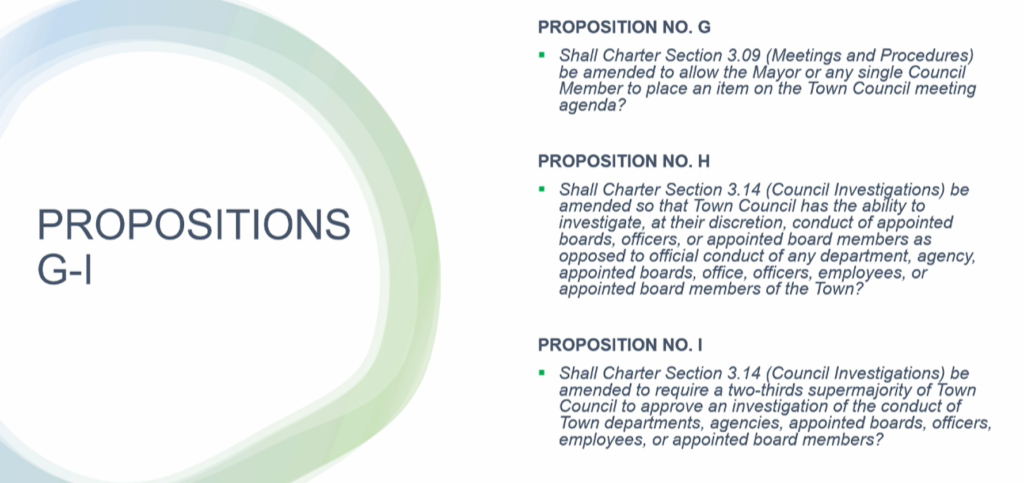
Proposition H increases the scope of the Town Council’s authority to investigate at their discretion ethics issues to include non-official activities, and Proposition I changes the procedure of these investigations to include that a supermajority of the Town Council must approve all investigations. So if we reject Prop H and pass Prop I, our Town Council would have even less power to prevent ethics violations today. Proposition I was added after comments from Council members in January expressing concern that spurious investigations could be started if the ethical claims didn’t need to be related to official duties, and the threat of these types of witch hunts would drive away potentially good council members from serving.
Rejecting Prop H and Prop I keeps the status quo on ethics investigations. Passing Prop H and rejecting Prop I significantly increases the scope of Council to punish ethics violations (some would say too much). Passing Prop H and passing Prop I could mean that a mostly-united Council can investigate ethics issues, with the super-majority requirement preventing harassment. Rejecting Prop H and passing Prop I is clearly the bad choice, as it keeps the scope of ethics violations the same but requires an even higher standard to investigate them.
We have some time to think this over.
The individual propositions are in the Town Council video, and I will submit a request and share the written copy of all of them here. As we get closer to the May 2nd election, I’d like to highlight viewpoints from the Town on the pros and cons of each measure. If you’d be interested in sharing your opinion publicly and making an argument for or against certain measures, please reach out to me at ben@sunnyvalecricket.com and I will share them as letters to the editor.
- The U.S. is actually one of the only developed countries to not hold elections on the weekend, according to a study by Pew Research. https://www.britannica.com/procon/election-day-debate#pcref-2255599-15 Some researchers and politicians have suggested that if we did move our elections to a weekend, we’d actually have higher voter participation. ↩︎










We already have a Library Board; it’s just not mandated in the charter.